Teaching My Omnipod to Love Me Back
By Honey

I took a break from my Omnipod for a while, but recently started wearing it again — this time more discreetly on my thigh, hip, or abdomen. It’s so comfortable now that I often forget it’s even there.
Still, for weeks, I’ve been frustrated with my blood sugars, wondering why my Omnipod seemed out of sync. My total daily insulin dose was less than 16 units, yet more than 72% of that was basal. My boluses barely showed up to the party. Last week, when my endocrinologist reminded me that it should ideally be closer to a 50/50 balance, something in me paused.
And then it hit me.
I realized I’d stopped sharing when I was being active — and I’d stopped entering my carbs. I’d been relying on corrections when my glucose went high and ignoring the conversation in between. My Omnipod — this small, faithful companion that stays with me through every moment — was trying to help me, but I wasn’t giving it the information it needed. I’d kept it in the dark.
Then, when I spoke with a Twiist representative, she explained something that flipped the light switch back on for me: with Twiist, even if you don’t finish your meal, you can go back and adjust the carbs in the app. The device can’t take back insulin already given — no device can — but it can learn from what actually happened. It just needs the full story to understand and adapt.
That’s when it clicked.
This is a relationship.
If I don’t tell my Omnipod what’s really going on — the meals, the movement, the choices, the life behind the data — it can’t possibly respond with accuracy or grace. It’s like a marriage where one partner stops sharing, leaving the other to guess what’s needed. You can survive that way, sure, but not thrive. The result? Constant reacting instead of harmonizing. Highs and lows instead of balance.
The beauty of these devices — these brilliant little tools — is that they’re designed to learn us. They grow smarter, more intuitive, and more attuned the more we trust them with information. But like any relationship, the magic only happens when we’re honest.
So, I’m learning to communicate again.
To log my carbs.
To tell my device when I’m active.
To let it do what it was made to do.
I can still override a bolus when my gut tells me to — but at least I’ve given it the chance to understand me.
It’s not about control; it’s about collaboration.
It’s about letting technology work with me instead of against me.
It’s about remembering that even in the science of diabetes, there’s an art to connection.
💛 Sometimes healing starts with honesty — not just with others, but with the tools, the people, and the parts of ourselves we’ve stopped trusting. Give your world the information it needs to love you back.
With grace, glucose, and gratitude,
— Honey 🍯
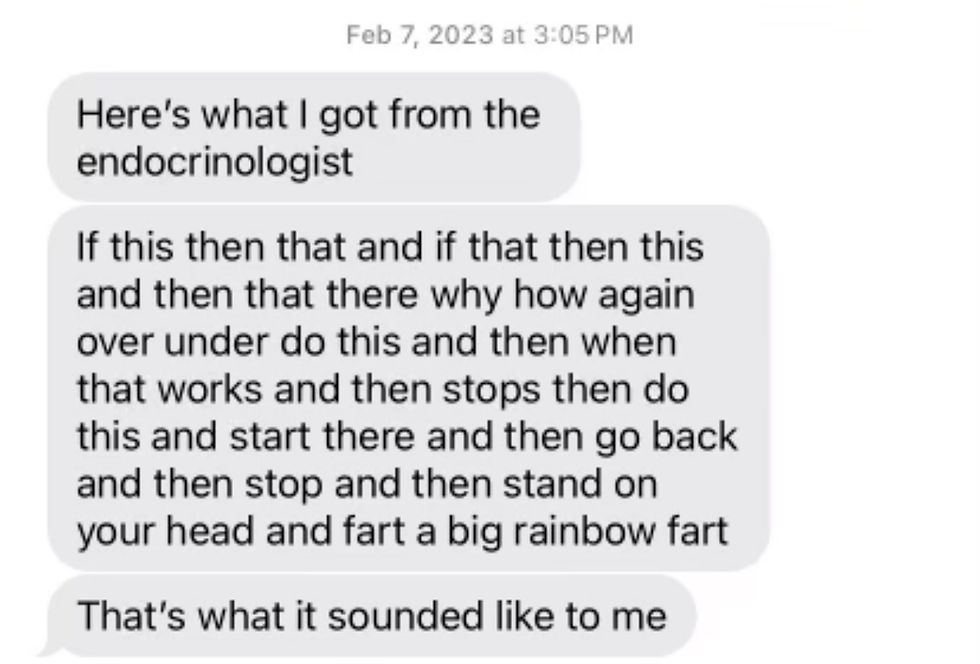
How I described learning how to manage T1D less than two weeks after having a total pancreatectomy. Bye-bye cancer - hello T1D.