Just a Girl in a Data-Driven World
I think a lot about what it means to be human in a world increasingly determined to measure everything.
Sleep scores. Glucose. Heart rate. Steps. Biological age. Productivity. Finances. Screen time. Location. Preferences. Algorithms predicting what we’ll click next.
We can measure more about ourselves than at any other point in human history.
And yet, I keep coming back to something remarkably simple:
I am not my data.
The data can teach me about myself. It can help me make better decisions. It can reveal patterns I could never possibly recognize on my own. In my case, it can quite literally help keep me alive.
But it cannot tell me whether I had a lovely day.
Granted, my phone asks me at least once a day if I’d like to log how I’m feeling, but so far I haven’t agreed to share quite that much. 😂
And even if I did, what would I enter for the feeling of my granddaughter reaching for her Honey’s hand?
What number represents the excitement on her face when she sees me?
There isn't a meaningful score for watching a sunset, laughing until your stomach hurts, falling in love, feeling brave when you're scared, or suddenly realizing you're happy for absolutely no particular reason.
Those may actually be some of the most important data points of our lives.
And they are almost entirely unmeasurable.
My Glucose Graph Has Opinions
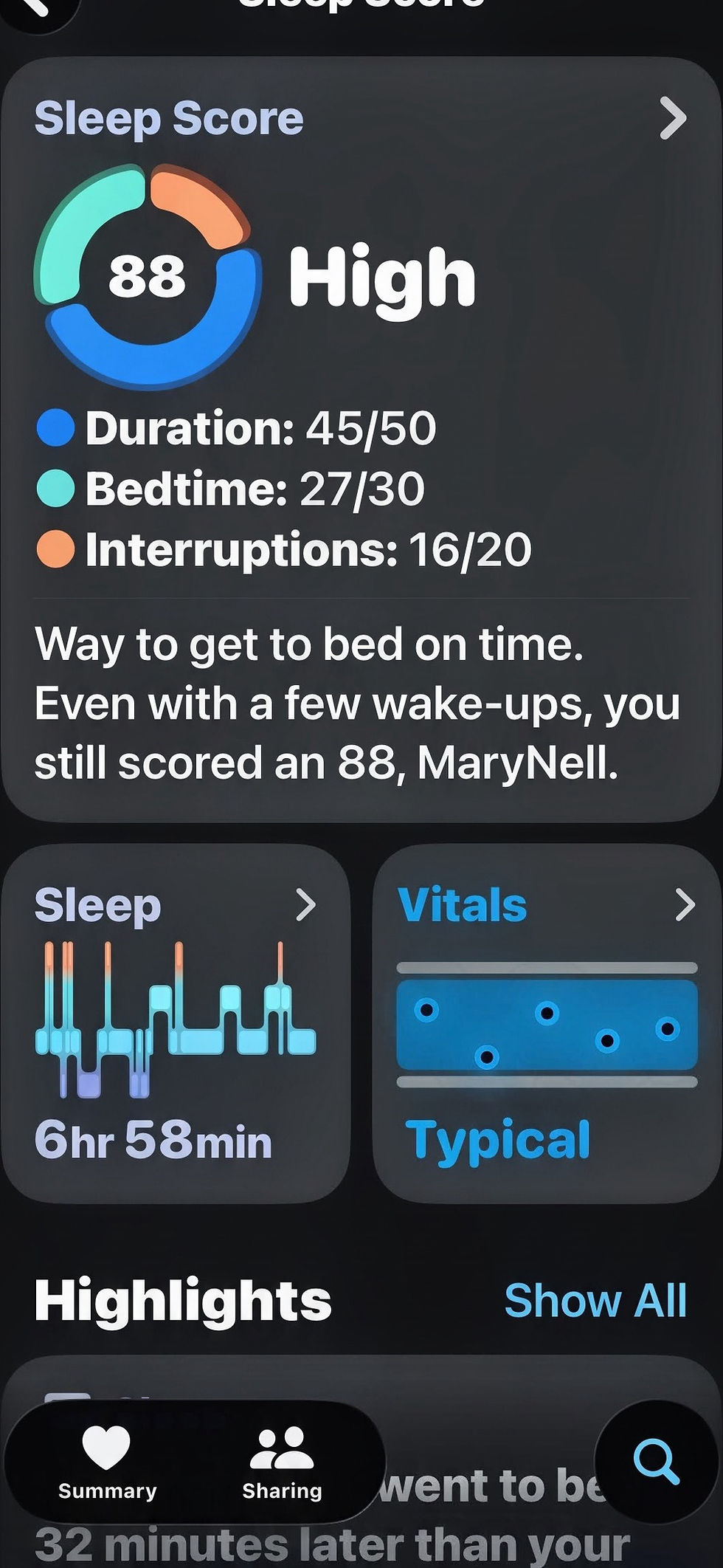
My watch occasionally informs me that I didn't sleep particularly well.
My glucose graph has lots of opinions.
My phone knows how many miles I walked, how long it took me, and the exact route I followed.
My calendar knows where I'm supposed to be.
Apparently an algorithm knows what I want to buy before I do—and, annoyingly, it seems to be remarkably accurate.
Meanwhile, I'm just a girl trying to decide what's for dinner. 😂
We are entering an extraordinary age in which we can know astonishing amounts about ourselves through biomarkers, wearables, genetics, continuous monitoring, connected devices, and increasingly sophisticated AI interpretation.
I find all of that incredibly exciting.
But underneath it is a philosophical question I think is worth asking:
When does information help us live better, and when do we start living for the information?
Measure what helps you.
Learn from what you measure.
Change what makes sense to change.
But don't become so busy tracking your life that you forget to experience it.
Some Data Matters More Than Others
I don't really have the option of ignoring all of my data.
My Dexcom and Omnipod are attached to my body, and my life quite literally depends on the information moving between them.
But what fascinates me is that even this technology is becoming increasingly personal.
My insulin needs aren't your insulin needs.
My patterns aren't someone else's patterns.
My Omnipod learns from me—from the information I give it, from my insulin requirements, and from what is happening in my body.
Did I eat?
Am I walking?
Am I lifting weights?
Am I sleeping?
Is my glucose rising or falling?
The goal isn't for my body to behave exactly like someone else's.
The goal is to understand my body well enough to take better care of it.
And perhaps that's one of the most promising things AI can eventually do for all of us.
For generations, much of medicine has necessarily relied on averages.
What happens to the average person?
What is the average risk?
What is the normal range?
Those population-level patterns are enormously valuable. We need them.
But none of us is actually an average.
We are each one person.
One collection of genetics, experiences, habits, environments, relationships, preferences, risks, strengths, vulnerabilities, and circumstances.
Mass data can teach us about millions of people. AI may help us understand what all of that information means for one.
And that distinction fascinates me.
Comparison Is Still Comparison
There's another danger hiding inside all this measurement.
Comparison.
We have known forever that comparing our lives to other people's lives can steal our joy.
Now we've simply invented thousands of new things to compare.
Their weight.
Their resting heart rate.
Their VO₂ max.
Their sleep score.
Their glucose.
Their pace.
Their biological age.
Their finances.
Their productivity.
Their streak.
Their whatever-the-next-app-decides-we-should-measure happens to be.
But someone else's number doesn't automatically need to become my goal.
We don't need to chase some magical weight or measurement simply because it works for—or looks good on—someone else.
Data is most useful when it helps us understand ourselves, not when it becomes another way to decide whether we're measuring up.
Let AI Help With the Boring Parts
Lately I've started experimenting with something much simpler.
I'm letting AI help manage pieces of my day.
Every morning, I get a briefing of my calendar. It helps me think about when I should work out, what needs my attention, what I might otherwise forget, and how the pieces of my day fit together.
I've only been doing it for a short time, but I've already noticed something interesting.
The value isn't that AI is helping me squeeze more productivity into every available minute.
It's almost the opposite.
It's helping me protect some of those minutes.
A reminder that I need to start my workout if I want time to finish it.
A reminder that everything on my list does not have to happen today.
A little assistance keeping track of the logistics so perhaps my brain doesn't have to.
And that is the future of AI that interests me most.
I don't want technology to make me better at being a machine.
I want technology to give me more time to be human.
More time outside.
More time traveling.
More time cooking something wonderful.
More time writing.
More time laughing.
More time holding a tiny hand that won't always be tiny.
More time noticing my actual life while I'm living it.
Because no matter how sophisticated our technology becomes, we still get one life.
And I'm not interested in spending mine trying to achieve a perfect score.
I want the information that helps me live better.
I want the technology that gives me time back.
I want AI smart enough to recognize that what is right for millions of people may not necessarily be right for me.
And then I want to put the phone down occasionally and go watch the sunset.
No rating required.
No optimization necessary.
No need to log how it made me feel.
I'll already know.
🍯 Honey Note
Measure what helps you grow, but never confuse what can be measured with what matters most.
Your watch may know how far you walked. Your calendar may know where you've been. Your biomarkers may tell a fascinating story about your health, and someday AI may understand patterns about you that you never could have discovered alone.
But none of them will ever fully understand the feeling of someone you love reaching for your hand.
So learn from the numbers. Use the tools. Be curious about what the data can teach you.
Then remember to look up.
Be the change. Be the inspiration. Be brave. Do really hard things. Never give up—and never let anyone steal your joy.
With a curious mind, an open heart, and apparently quite a lot of data,
Honey 🍯
Apparently, according to the data, I’m doing okay. 😂
I turn 56 next week, but over the last 51 months I’ve gained exactly one pound, my scale says I’ve biologically aged only two years, and it currently considers me 50—six years younger than my soon-to-be chronological age.
And lately, I’m even sleeping pretty darn well. Alone. Happily. 😂
Turns out I did find someone to fall completely in love with, though. She’s tiny, hilarious, wildly energetic, full of personality, and calls me Honey. 🍯
So while I’ll never let a scale, watch, glucose graph, sleep score—or any other piece of data—define me, I have to admit I’m rather fond of that little “Metabolic Age: 50.”
Not because I’m afraid of getting older.
Quite the opposite.
I want as much getting older as life will give me.
I have a little girl I plan to watch grow up. 💛
So here’s to 56, good data, good sleep, strong muscles, a very happy heart—and doing everything I reasonably can to stick around for a whole lot more birthdays.
Because sometimes the most meaningful reason to care about the numbers has absolutely nothing to do with the numbers. 🍯