The Architecture of Trust: Protecting Our Vulnerabilities from Being Weaponized
We like to think of growth as a straight line.
We imagine that as we spend years working on ourselves, processing past hardships, healing from life's challenges and health issues, learning better boundaries, and quietly building our inner strength, we eventually become somewhat bulletproof.
We tell ourselves that the stronger and wiser we become, the less likely we are to be misled.
It is a comforting thought.
But lately, my evening deep-dives into human behavior have made me see things a little differently. Between falling down fascinating documentary rabbit holes and listening to people who need a safe, non-judgmental place to vent, I often get stuck on certain ideas. I start pulling at a thread, wondering about the psychology and logistics of how people navigate relationships, and eventually realize just how beautifully—and sometimes painfully—complex human beings are.
Lately, I have also half-jokingly, though somewhat genuinely, wondered whether perhaps we are living in a simulated reality. Maybe when life is going along swimmingly and seems all but perfect, the hiccups and occasional hand grenades interrupting us are just another player's controller messing with whoever is controlling our little avatar.
I mean, it's a possibility.
But simulation theory aside, one idea keeps demanding my attention:
Becoming stronger does not mean becoming invulnerable.
Even when we stand at the threshold of becoming our strongest selves, tender places within us can remain.
Sometimes vulnerability arrives through a frightening health crisis—a diagnosis, major surgery, or suddenly learning how to live inside a body that requires an entirely new kind of attention. Sometimes it comes through burnout, grief, loneliness, caregiving, professional pressure, feeling as though we are not enough, believing our life's baggage has become too heavy to carry, or enduring a long season of feeling strangely unseen.
These aren't character defects.
They are simply part of being human.
Looking back over the last decade of my own life and the health challenges I have faced, I'm actually not supposed to be here.
But here I am.
Cancer-free. Sans pancreas, as well. Very much alive, very active, very well—and sometimes, perhaps, appearing stronger than I actually feel.
Because at the end of the day, I am human too.
I have challenges. Sometimes it's a low blood sugar. Sometimes it's stress sending my blood sugar soaring and requiring me to stop whatever I'm doing and manage it. And let's be honest: those things can affect our mood, our thinking, our patience, and so much more in our lives.
They don't stop me from working, traveling, being active, or living an incredibly full life.
But they remind me that I am not bulletproof.
None of us are.
We all have something going on.
Hard seasons consume enormous amounts of energy. When so much of us is devoted simply to getting through the day, we may have less energy available for questioning the intentions of people we already trust.
And that is where trust becomes interesting.
Trust Is an Architecture
Trust isn't simply believing someone.
It is an architecture we quietly build around another person over time.
We collect evidence: years of familiarity, shared experiences, professional credibility, friendship, kindness, consistency.
Eventually, we stop examining every interaction because that is precisely what trust allows us to do.
We relax.
Normally, that is a beautiful thing.
But it also means that someone who has occupied a trusted place in our lives may have access to vulnerabilities a stranger never could.
When we deeply trust someone—especially someone who has held a respected place in our world—we naturally assume mutual care. We assume that even if feelings become complicated, this person cares enough about our well-being not to introduce unnecessary chaos into our lives.
And during a vulnerable season, intense attention can feel especially powerful.
Romantic words.
Persistent pursuit.
Poetry.
Grand declarations.
Small, thoughtful gifts for no reason other than someone paid attention to the little things you mentioned loving.
Promises of a different future.
The intoxicating suggestion that someone understands you in a way no one else quite does.
The blinding words that someone loves you more deeply than they have ever loved another person and simply cannot keep that truth inside for one more moment.
None of those things automatically mean manipulation.
Human relationships are far too complicated for that.
People can mean something deeply in one moment and prove incapable of living up to it the next.
But eventually, words have to survive contact with real-world behavior.
That may be one of the most useful lessons we can carry forward.
Watch What Requires Darkness
When an emotional relationship crosses a boundary, secrecy can initially masquerade as protection.
We may hear familiar pleas to be careful, to trust the person, to trust the timing, and to keep things hidden—just for a little while.
We need to be careful. I will do anything to prove my love to you.
I know the timing isn't right, but please trust me. I'm yours. Please love me back.
Some of those statements may even be completely sincere in the moment.
But over time, the logistics of the behavior tell a clearer story.
If a relationship can exist only through private conversations, disappearing messages, handwritten notes, carefully controlled encounters, or communication deliberately designed not to leave a trail, it is worth asking a difficult question:
Who is this secrecy actually protecting?
Because love and secrecy are not the same thing.
Privacy can protect something precious.
Secrecy often protects someone from consequences.
There is an important difference.
Someone who genuinely intends to build a life with another person eventually has to make real-world choices. Existing relationships have to be resolved honestly. Difficult conversations have to happen. Decisions have consequences. Lives cannot remain indefinitely suspended somewhere between promises and reality.
At some point, love has to survive daylight.
In our modern world, one fairly simple gauge is whether someone is willing—and perhaps even excited—to let your relationship exist openly. Not every person wants their life on social media, and privacy is perfectly healthy. But if you are specifically expected to conceal a relationship and the joy it brings to your life so another person can protect the stability of theirs, that deserves your attention.
If one person is expected to assume the risk while the other preserves their safety, that isn't an equal partnership.
You may have become an escape from someone's reality rather than part of the future they promised.
That distinction hurts.
But it matters.
When the Switch Flips
Perhaps one of the most disorienting experiences is watching someone who once made you feel extraordinarily seen suddenly become distant.
The warmth disappears.
The private language vanishes.
The person who once found endless reasons to seek you out—perhaps even showing up at your home unannounced as though access to you were theirs—can suddenly behave as though there is nothing meaningful to acknowledge at all.
Communication may become sterile and transactional.
Eye contact disappears.
Third parties sometimes become intermediaries.
And the silence can begin to feel as though the past itself is being erased.
That abrupt shift can be profoundly destabilizing.
There is a strange moment when you almost want to say:
Wait. You were there too.
I did not imagine an entire chapter of my own life.
I don't pretend to know exactly what happens inside another person's mind when that switch flips. Maybe it is fear. Shame. Guilt. Regret. Self-preservation. Maybe it is simply avoidance.
Perhaps it is some complicated combination of all of them.
But whatever is happening inside them does not make the experience any less real for the person standing on the other side of their silence.
And this is something I wish we talked about more:
Our bodies often recognize relational danger before our minds have completely organized the story.
The nausea.
The racing heart.
The sudden anger.
The sleepless nights.
The elevated blood sugar.
The hypervigilance.
The strange feeling of bracing yourself simply because someone entered the room.
The stress response that seems to arrive before you've consciously thought a single thought.
Those sensations deserve attention.
Not because every uncomfortable feeling proves another person's intentions, but because our nervous systems are constantly gathering information about whether an environment feels predictable and safe.
Sometimes healing begins by respecting that information.
Build a Structural Shield
When complete physical distance isn't immediately possible, you can deliberately build emotional distance.
Reduce unnecessary interactions.
Keep communication clear, brief, and appropriate to the environment.
Limit unnecessary one-on-one access.
Remove opportunities for ambiguous encounters.
And if mutual acquaintances inadvertently become conduits through which someone continues to receive information about your life, it may even become necessary to reconsider what you share and with whom.
Not as punishment.
As protection.
And perhaps most importantly, redirect the enormous amount of energy once spent interpreting another person's behavior toward building your own life.
There is something extraordinarily stabilizing about realizing:
I can build a future that does not require this person to understand me, validate me, choose me, apologize to me, or even tell the truth about what happened.
That is autonomy.
Forgiveness Does Not Require Access
I think we sometimes confuse forgiveness with reconciliation.
They are not the same thing.
Forgiveness can be something we do privately because we no longer want anger renting space inside us. It can mean accepting that we cannot rewrite the past and deciding we are unwilling to drag it into every beautiful thing waiting ahead.
And sometimes the forgiveness we most need to extend is toward ourselves.
For believing someone.
For ignoring something we now recognize.
For allowing boundaries to blur.
For giving someone access to our life that, in hindsight, we wish we had protected differently.
For finding ourselves left to clean up emotional chaos we didn't create alone.
We may eventually forgive another person.
We may not.
Either way, perhaps we can forgive ourselves.
Reconciliation is different.
Reconciliation requires trust.
You can forgive someone and still decide they no longer have unrestricted access to you.
You can even wish someone well from a distance.
You can understand that imperfect people sometimes make selfish, frightened, complicated decisions without volunteering to absorb the consequences of those decisions forever.
Grace and boundaries can occupy the same room.
We don't need to build stone walls that keep the entire world out. We need to become more intentional about who is safe enough to be let past the front gate.
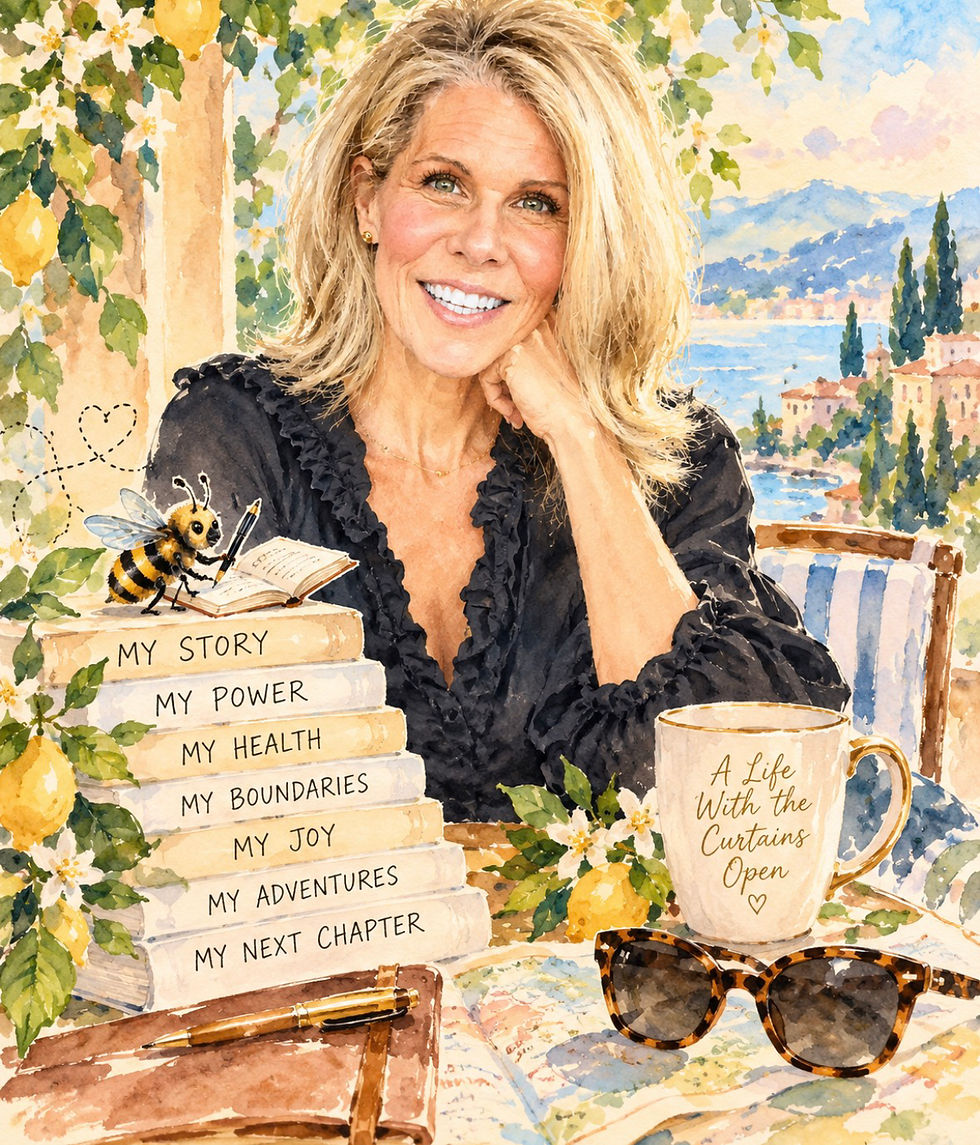
We Don't All Live With the Curtains Open
Another layer to all of this deserves some grace.
Not everyone wants to live transparently.
Some people are intensely private. Some compartmentalize their lives. Some protect painful truths because they fear judgment, consequences, disappointment, or simply the discomfort of being fully known.
And some people may genuinely prefer not to know every difficult truth themselves because not knowing makes acceptance—or perhaps life itself—feel easier.
I am not sure there is one universally right way to move through the world.
But I do know that some of us breathe more freely with the curtains open.
Some people would rather tell the truth about the beautiful parts and the messy ones—the mistakes, the heartbreaks, the embarrassing chapters, the failures, the illnesses, the poor decisions, the moments when we absolutely did not have life figured out.
Not because every detail of a life belongs to everyone.
It doesn't.
But because refusing to build a life around shame can bring tremendous freedom.
And sometimes, without even realizing it, people who are comfortable living openly can find themselves carrying the shame of people who aren't.
We begin protecting secrets we didn't create.
Editing stories that aren't ours.
Monitoring what can be said, where it can be said, and who might hear it.
We learn which subjects to avoid and which pieces of history must quietly disappear.
That is exhausting.
Respectfully protecting another person's privacy is very different from being expected to participate in erasing your own lived experience.
Someone else's silence does not rewrite history.
And telling the truth about our own lives does not automatically mean we are trying to expose or punish someone else.
Sometimes it simply means we have decided shame will not narrate our story.
In fact, I think there is something quietly generous about people who are willing to say:
This happened to me.
I made this mistake.
I loved the wrong person.
I trusted when perhaps I shouldn't have.
I got sick.
I fell apart.
I stayed too long.
I left.
I offered them yet another chance.
I started over.
I survived.
Because somewhere, someone hears that truth and thinks:
Oh. Me too.
And suddenly they feel a little less strange.
A little less ashamed.
A little less alone.
Perhaps that is one of vulnerability's greatest gifts.
When we are willing to tell the imperfect truth about being human, we quietly permit other people to remain human too.
Life does not have to be spotless to be beautiful.
The truth doesn't always make us look our best. Sometimes it reveals decisions we regret or chapters we would write differently today.
But I would rather allow an imperfect truth to breathe than spend enormous energy maintaining a perfect illusion.
That is simply the way I choose to live.
Others are entitled to choose differently.
But none of us should be required to carry another person's shame simply because they have chosen not to face it themselves.
Some Debts Are Not Ours to Pay
This may matter most when relationships, promises, and commitments have been broken.
It can be tempting to absorb responsibility for an entire complicated story—to wonder what we should repair, whom we should protect, what truths we should continue carrying, whom we should apologize to, and whether our silence somehow makes things easier for everyone else.
But responsibility has boundaries too.
I remind myself:
Their silence does not rewrite history. The vows or promise's someone made—and the responsibility for repairing the ones they broke—belong to the person who made them. That debt is theirs to pay, not someone else's to carry.
That isn't cruelty.
And it isn't an attempt to escape responsibility for our own choices.
We can look directly at our part in something.
We can acknowledge where we wish we had chosen differently.
We can apologize where an apology is ours to give.
We can learn.
We can change.
We can refuse to repeat the same mistake.
But accountability is not the same thing as accepting ownership of someone else's commitments.
If someone owes another person honesty, that honesty belongs to them.
If trust needs rebuilding, that work belongs to them.
If a relationship needs repair, the people who made the promises within that relationship ultimately have to decide what truth, forgiveness, and repair look like for them.
We cannot do that work for them.
And we cannot force someone to hear an apology simply because we are ready to give one.
Sometimes all we can do is make one sincere attempt to own whatever portion belongs to us.
The other person is free to listen, decline, forgive, stay angry, believe something different, or choose whatever version of the future lets them move forward.
That is their right.
An apology does not become meaningless simply because it isn't received.
Sometimes the willingness to say I am sorry for my part is itself part of putting down a burden.
Not because it absolves us.
Because it acknowledges what belongs to us—and, just as importantly, what does not.
Perhaps one of the final acts of closing a complicated chapter is learning to put down what was never ours to carry.
Their secrets.
Their shame.
Their unfinished conversations.
Their explanations.
Their debt.
We can leave those things where they belong and still walk away with compassion.
Because living with the curtains open doesn't mean throwing stones through someone else's windows.
It simply means refusing to darken our own.
And perhaps we should remember something else while we're at it:
Just because another person sins differently than we do doesn't make either of us more human—or less human—than the other.
Humility lies in acknowledging where we wish we had chosen differently.
Growth comes from examining why something reached us when it did.
Wisdom lies in recognizing the boundaries we would never allow to blur again.
Eventually, we have to return each burden to its rightful owner.
The Goal Is Not to Become Harder
After trust has been weaponized, it's understandable to want to become impossible to reach.
To question everyone.
To reveal nothing.
To build walls so high that nobody ever gets close enough to hurt us again.
But I don't think that is the lesson.
The goal isn't to become harder.
The goal is to become more discerning about who receives access to our softness.
We should still trust people.
We should still fall in love.
We should still tell our stories, take chances, believe beautiful things, forgive imperfect humans, and remain open to being surprised by life.
And yes, even those of us who want to save intimacy for someone who tells us they love us—and whom we believe we love in return—have to accept an uncomfortable truth:
Sometimes I love you is still just words.
Beautiful words.
Convincing words.
Words we may desperately want to believe.
And any of us can be fooled by words.
That doesn't mean we stop believing in love.
Love is a risk.
So are many of the most wonderful things in life.
I would rather learn to pay closer attention to whether the words and behavior match than decide never to risk believing anyone again.
Because you never know when you might find the real thing.
Perhaps wisdom teaches us to pay closer attention to the architecture.
Who shows up consistently?
Whose words match their actions?
Who protects our vulnerability rather than using it as an entry point?
Who is willing to make difficult choices rather than asking us to quietly absorb the consequences of their indecision?
And perhaps most importantly:
Who will stand beside us in the daylight?
The safest relationships aren't necessarily the ones without complications.
Human beings will always be complicated.
They are the ones where truth does not require hiding.
Where affection does not require erasure.
Where vulnerability is treated as something precious rather than something useful.
And where being loved never requires disappearing.
We cannot make ourselves invulnerable.
Nor should we want to.
Our tenderness helps us experience extraordinary joy, intimacy, friendship, curiosity, adventure, and love.
We simply become wiser architects.
We learn where the doors belong.
We learn when to close them.
And we become much more thoughtful about who gets a key.
🍯 Honey Note
There is no shame in having trusted someone.
Trust isn't evidence that you were foolish. It is evidence that you were willing to believe another human being would handle your vulnerability with care.
The lesson isn't to lock every door.
It is to notice who knocks gently.
Who waits to be invited in.
Who treats what they discover inside with tenderness.
And who is willing to stand beside you once the curtains are open.
You can carry the wisdom without carrying someone else's debt.
You can forgive the past without giving it a key to your future.
You can own the parts of your story you wish you had written differently without allowing those pages to define the entire book.
And you can remain soft without remaining unprotected.
Maybe that is the architecture we are really building.
Not walls.
A home within ourselves where truth is welcome, shame doesn't get its own bedroom, the curtains can stay wide open, and the people we invite inside understand what a privilege it is to be there.
With an open heart, stronger boundaries, and plenty of room left for life to surprise me,
🍯Honey